
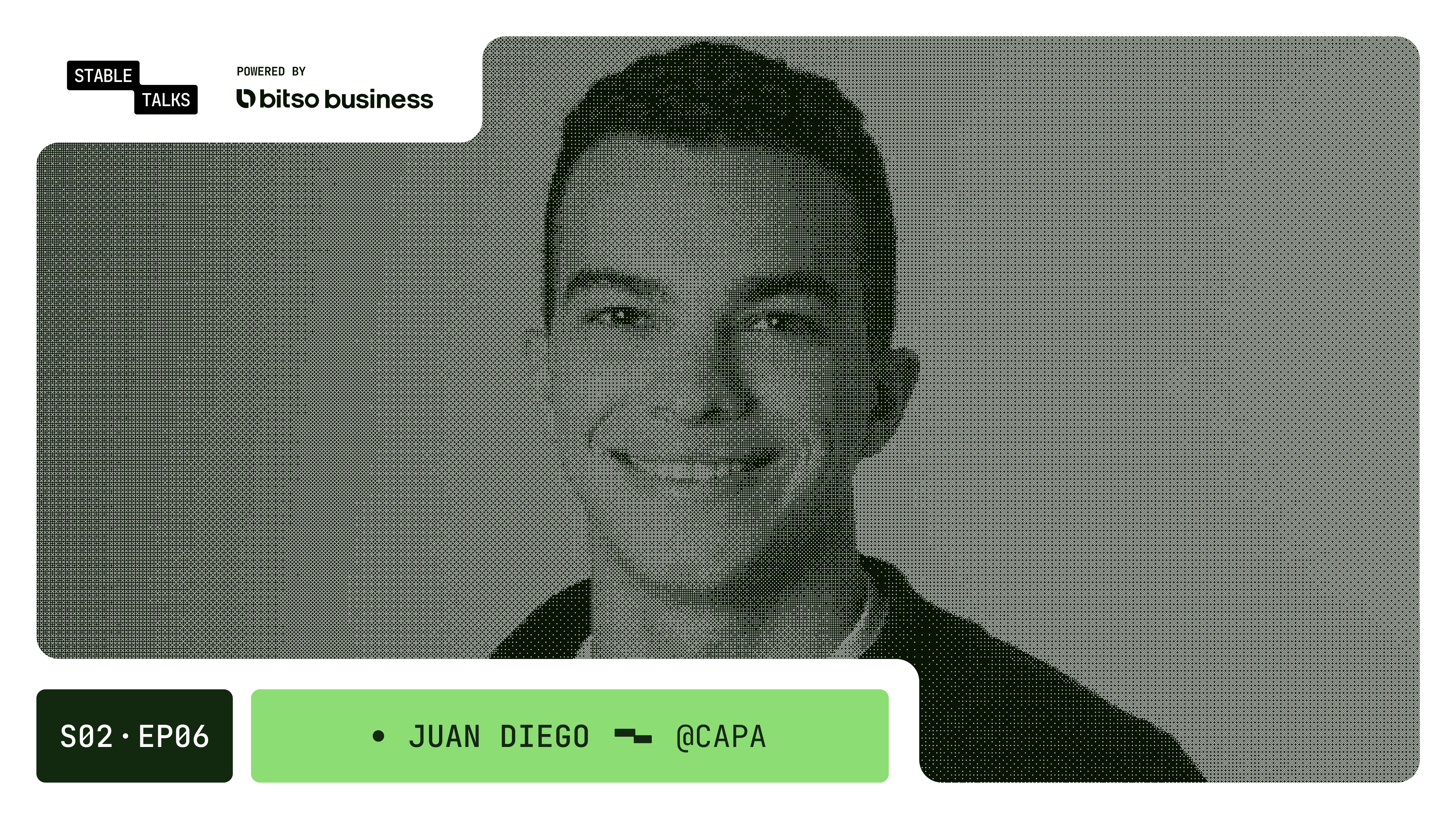
In the sixth episode of Season 2 of Stable Talks powered by Bitso Business, Caio Barbosa (Co-Founder & CEO at Lumx) and Julián Colombo (Senior Director, South America at Bitso) welcome Juandi, Founder & CEO of Capa, for a deep, founder-level conversation on how stablecoins are evolving into real payment infrastructure.
From informal arbitrage desks to enterprise FX flows across Latin America, North America and China, Juandi shares what changes when stablecoin companies grow up, and why scaling payments is far more complex than moving tokens.
🎧 Listen to the full episode below or read on for the main highlights.

Highlights from the conversation
1. From arbitrage to enterprise FX
“I solved my own problem first, then I realized thousands of companies had the same one.”
— Juandi
Juandi started using stablecoin arbitrage to pay for college.
Capa was born when that same logic was applied at scale: helping companies move money across borders with tighter spreads, faster settlement and better visibility than traditional FX rails.
2. Why B2B beats B2C in emerging markets
“The markets that scale first are enterprise, not retail.”
— Juandi
The episode draws a clear distinction:
Brazil and Mexico are primarily B2B payment markets
Other LatAm countries still see heavy consumer flows
Stablecoins shine where tickets are large, margins are tight and predictability matters.
3. Pricing compression and the end of easy margins
“Today, pricing alone won’t differentiate you anymore.”
— Juandi
As regulation advances and competition increases, spreads tighten.
What starts to matter more:
Liquidity access
Operational reliability
Customer service at founder-level attention
4. Talking to banks is no longer optional
“Banks aren’t dumb. They’re rational.”
— Juandi
As stablecoin companies scale, they inevitably interact with banks, for FX, liquidity, compliance and settlement.
Juandi explains how:
Volume changes the conversation
Regulation unlocks trust
Shortcuts always come back to hurt you
5. China corridors and real-world complexity
“China is hard, but that’s exactly why it matters.”
— Juandi
Operating Mexico–China and Brazil–China corridors reveals the true complexity of payments:
Invoices, documentation and RFIs
Correspondent banks and compliance layers
Human problem-solving, not just APIs
This is where stablecoins stop being abstract and become operational.
6. Partnerships over lone-wolf strategies
“Nobody wins alone in payments infrastructure.”
— Juandi
Instead of competing with everyone, Juandi argues that:
Infrastructure companies must complement each other
Partnerships unlock liquidity and distribution
Mature markets reward collaboration, not isolation
7. 2026 outlook: payments over hype
“The real use case is moving large amounts of money, fast and reliably.”
— Juandi
Looking ahead, Juandi predicts:
Consolidation and M&A
Stablecoins embedded inside banks and enterprises
Payments chains winning over general-purpose narratives
Stablecoins are growing up
This episode makes one thing clear:
the stablecoin industry is entering its adult phase.
Less hype.
More regulation.
More responsibility.
And a lot more real money moving.
“The opportunity isn’t disappearing — it’s maturing.”
— Juandi (Capa)
How did Capa evolve from stablecoin arbitrage to enterprise FX infrastructure?
Capa's founder Juandi started using stablecoin arbitrage to pay for college, then realized thousands of companies had the same need for cheaper cross-border transfers. By applying the same logic at enterprise scale — helping companies move money across borders with tighter spreads, faster settlement, and better visibility — Capa transitioned from informal arbitrage to regulated B2B FX infrastructure.
Why is B2B the bigger opportunity for stablecoins in Latin America?
Brazil and Mexico are primarily B2B payment markets where transaction tickets are large, margins are tight, and predictability matters most. While consumer flows dominate in some Latin American countries, enterprise payments represent the larger opportunity because stablecoins directly address the pain points of high costs, slow settlement, and limited banking access that businesses face in cross-border operations.
Why do stablecoin companies inevitably need banking relationships to scale?
As stablecoin companies grow, they need banks for FX conversion, liquidity access, compliance infrastructure, and fiat settlement. Volume changes the conversation — banks respond to scale. Regulation unlocks trust between the two sides. Trying to bypass banking relationships through shortcuts always creates problems later, making direct engagement with banks a prerequisite for sustainable growth.
Why is pricing alone no longer enough to differentiate stablecoin payment companies?
As regulation advances and competition increases across stablecoin payment corridors, spreads are compressing rapidly. What differentiates companies now is liquidity access, operational reliability, and founder-level customer service. Companies that relied solely on tighter pricing are finding it unsustainable as the market matures and clients demand more comprehensive infrastructure and support.


