
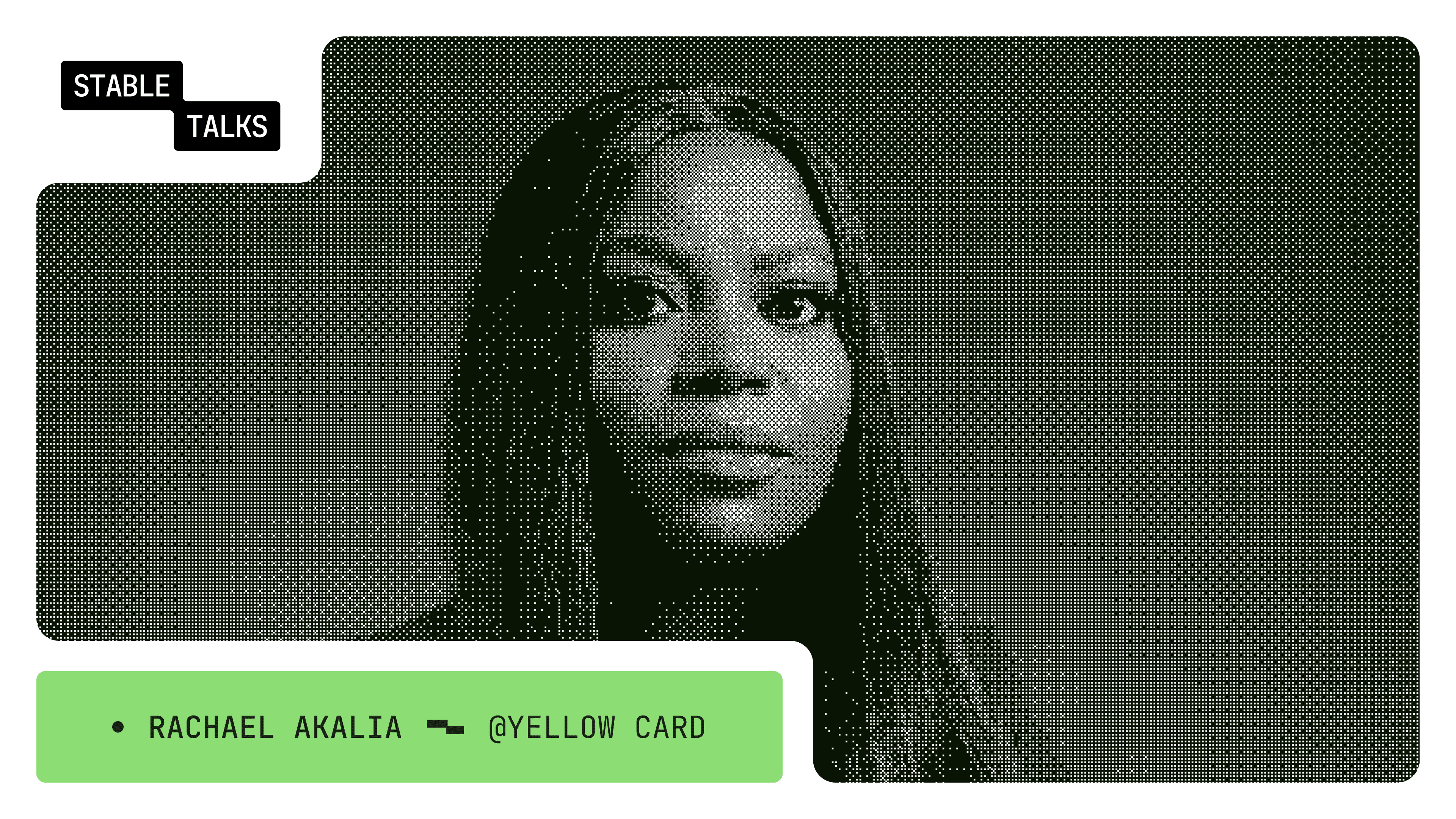
In the third episode of Season 2 of Stable Talks powered by Bitso Business, Caio Barbosa (Co-Founder & CEO at Lumx) and Julián Colombo (Senior Director, South America at Bitso) welcome Rachael Akalia, Regional Marketing Manager at Yellow Card, for a deep dive into how Africa is becoming one of the most active and innovative stablecoin markets in the world.
From Nigeria to South Africa, the conversation unpacks how Yellow Card evolved from a retail exchange to a B2B payments infrastructure, powering instant cross-border settlements and helping enterprises move millions in stablecoins. Rachael also discusses how regulation is shaping adoption across the continent — and why Africa’s story mirrors the path taken by Latin America.
🎧 Listen to the full episode below or read on for the main highlights of the conversation.

Highlights from the conversation
1. From portfolio management to crypto infrastructure
“I started by helping high-net-worth clients manage portfolios, now I help enterprises move millions in stablecoins.”
— Rachael Akalia
Rachael shares her journey from traditional finance into crypto, joining Yellow Card to lead marketing across West and Francophone Africa.
She explains how her team’s focus shifted from education and awareness in the B2C era to product-led growth in B2B, helping companies use stablecoins to move real value across borders.
2. From retail exchange to B2B payments network
“We moved from helping individuals store value to helping enterprises settle invoices instantly.”
— Rachael Akalia
Yellow Card’s evolution reflects the broader trend in emerging markets: from retail adoption to enterprise-grade infrastructure.
Rachael details how Yellow Card’s new APIs and treasury tools enable companies to send and receive large payments across Africa using stablecoins, cutting fees and delays tied to traditional systems.
3. Regulation as the turning point
“The minute regulation went live in Nigeria, banks changed their stance on crypto in 24 hours.”
— Rachael Akalia
The episode highlights how regulation can make or break crypto adoption.
Nigeria’s recent SEC and CBN frameworks unlocked new banking partnerships and confidence, while Ghana’s regulatory hesitation slowed momentum.
South Africa, on the other hand, is emerging as a model with its proactive sandbox approach.
4. CBDCs vs. stablecoins
“Nigeria launched a CBDC, and no one used it. People already had stablecoins solving their problems.”
— Rachael Akalia
Rachael compares Africa’s CBDC experiment with Brazil’s DREX initiative, discussed by Caio and Julián.
Both cases show that government-led digital currencies struggle to match the flexibility and adoption of privately issued stablecoins, especially in economies where innovation happens bottom-up.
5. Global signals: Genius Act, Clarity Bill, and pro-crypto policy
“When the US takes a pro-crypto stance, it gives emerging markets the green light to innovate.”
— Rachael Akalia
The conversation connects the dots between global regulatory progress, like the Genius and Clarity Acts in the US, and its ripple effects in emerging economies.
For Africa, this alignment with global standards could fast-track enterprise adoption and international partnerships.
6. The next frontier: B2B integrations and Visa partnership
“Our integration with Visa changed everything — if Visa trusts Yellow Card, enterprises do too.”
— Rachael Akalia
Rachael reveals how Yellow Card’s recent Visa integration has been a major catalyst for enterprise onboarding.
The partnership signals a new phase for African fintechs, where local innovation meets global trust networks.
Africa and Latin America: parallel stories of adoption
Caio and Julián draw powerful parallels between Africa and Latin America, both regions where inflation, capital controls, and limited financial access have turned stablecoins into tools of necessity rather than speculation.
From Brazil’s tokenization experiments to Nigeria’s cross-border commerce, the message is clear: emerging markets are leading the real-world adoption of stablecoins.
“It’s the best time ever to be building with stablecoins.”
— Caio Barbosa (Lumx)
Stablecoins: from survival to infrastructure
This episode paints a vivid picture of how stablecoins have evolved from hedging tools into the backbone of real financial systems in emerging economies.
For Africa, as for Latin America, regulation, B2B adoption, and collaboration with traditional finance will define the next stage of growth.
“When trends like this happen, you either adopt, evolve, or get left behind.”
— Rachael Akalia (Yellow Card)
How is Yellow Card using stablecoins for cross-border payments in Africa?
Yellow Card evolved from a retail crypto exchange into a B2B payments infrastructure, enabling enterprises to move millions in stablecoins for instant cross-border settlements across Africa. From Nigeria to South Africa, the company powers real-time transfers that bypass traditional banking limitations, helping businesses settle payments faster and more affordably.
Why is Africa becoming one of the most active stablecoin markets in the world?
Africa's combination of limited banking infrastructure, high remittance costs, and growing digital adoption has created fertile ground for stablecoin use. Countries like Nigeria and South Africa are seeing rapid adoption as stablecoins solve real problems — from currency instability to expensive cross-border transfers — mirroring the adoption path seen in Latin America.
How is regulation shaping stablecoin adoption across Africa?
Regulation varies significantly across African markets, with some countries embracing digital assets through licensing frameworks while others maintain restrictive stances. As discussed in the episode, progressive regulation in key markets is accelerating institutional adoption, while companies like Yellow Card work within local regulatory environments to build compliant infrastructure.
What parallels exist between stablecoin adoption in Africa and Latin America?
Both regions share similar drivers for stablecoin adoption: currency volatility, high remittance costs, limited access to international banking, and a young, digitally native population. The conversation highlights how Africa's stablecoin trajectory mirrors Latin America's path, with B2B use cases and cross-border payments leading the way toward mainstream adoption.


