

Stable News is Lumx’s weekly curation dedicated to tracking the key movements in stablecoins, digital infrastructure, and the future of global payments.
In recent weeks, the discussion around stablecoins has been shaped by scale projections, regulatory advances, disputes with banks, institutional positioning, and structural questions about the current model. This edition, however, departs from the traditional format, not because the news has lost relevance, but because it points to a deeper shift in the nature of the conversation.
Reading time: 6 minutes
When the conversation matures, the problem changes
For a long time, stablecoins were treated as a thesis, something that needed to be explained, defended, and contextualized. The core question was simple: does this make sense?
That stage is starting to fall behind. The debate moves away from territorial discussions about legitimacy or viability and becomes operational. The conversation now takes place at another level: where these structures already operate within regulated flows, how they coexist with legacy systems, which risks are real, and which stem from information asymmetries or flawed design.
This shift is not trivial. It reflects a moment in which stablecoins stop being analyzed as a product or isolated innovation and start being treated as financial infrastructure. And, like any infrastructure, the value is not in the narrative but in the flow: who operates, who approves, who settles, who carries risk, and who is accountable when something goes off track.
It is precisely at this point that many discussions stall—not due to technological limitations, but because infrastructure decisions require clarity, coordination, and organizational maturity, attributes that go far beyond innovation rhetoric.
The real bottleneck is not technology
Over the past year, in conversations with banks, fintechs, and payment institutions, one question kept coming up with only minor variations:
“Stablecoins make sense, but where do we start? What are the legal implications?”
This doubt reveals more than a technical gap. It exposes a recurring internal misalignment. While the topic advances at the strategic level, implementation falls on structures that must answer to compliance, controls, audit, and operational continuity.
The institutions that managed to move forward were those that inverted the traditional innovation logic. Instead of starting with technology, they started with governance. Before discussing rails, they discussed responsibilities. Before talking about efficiency, they mapped failure points. Before integrating systems, they designed clear and traceable financial flows.
Where the discussion remained stuck, the pattern was also consistent: fear of making mistakes, excessive abstraction, and difficulty bringing risk, compliance, and operations teams into the center of the conversation. The result was not healthy caution, but decision paralysis.
In this context, stablecoins stop being an innovation topic and become a test of organizational maturity.
Conversations that don’t fit on a stage
It was from this realization that Lumx began, over the past year, to conduct technical discussions directly within financial institutions through Lumx In Company.
No stage, no sales pitch, no generic presentations. Just operations, product, risk, compliance, and strategy teams discussing real implementation. These conversations took place with institutions such as Banco Inter, Banco do Brasil, Banco Arbi, Ouribank, and dLocal, as well as associations like ABBC and Febraban.
The accumulation of these experiences, combined with growing market demand, led to the next step.
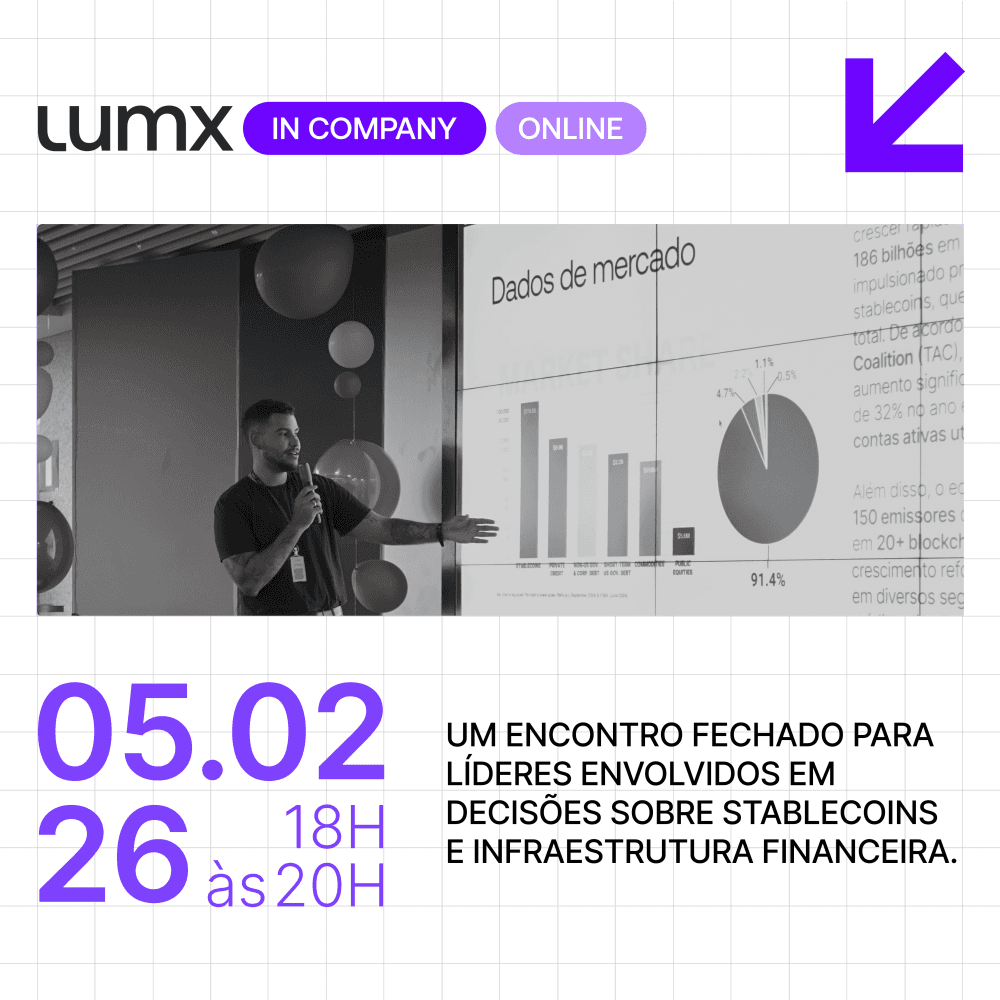
Lumx In Company – Online
This special edition is also an invitation.
Lumx In Company – Online was not designed to discuss whether stablecoins make sense. That debate has already been settled by the market, regulation, and institutional adoption. The focus here is different: how to implement, where it makes sense to move forward now, and where it does not.
This is a closed, technical, and pragmatic meeting aimed at professionals directly involved in financial infrastructure decisions. The goal is to move beyond the conceptual plane and discuss, based on data and real cases, topics such as:
Financial flow design
Integration with legacy systems
Governance and operational risk
Compliance structuring
Internal team enablement
For the first time, this format is being brought online, while maintaining the same curatorial rigor applied to the in-person editions held over the past year.
Event details:
Date: February 5
Time: 6:00 pm – 8:00 pm
Format: Online
Up to 3 participants per company (involved in infrastructure decisions)
Maximum of 100 participants
Confirmations on a first-come, first-served basis
Register here
Complementary reading of the week
For those who want to follow the most recent market movements:
Tether launches a regulated stablecoin for the U.S. market
Hong Kong is expected to issue stablecoin licenses still in Q1
Circle CEO says stablecoins will have a major future with AI agents
Standard Chartered views stablecoins as a threat to bank deposits
Watch the latest episode of Stable Talks, S02E06 with Juan Diego, CEO of Capa
The moment is clear: stablecoins are moving toward becoming critical infrastructure. And every piece of critical infrastructure, at some point, demands mature decisions.
More than understanding the topic, the question now is who is prepared to implement it correctly.
See you in the next edition. 💜
When did stablecoins stop being a thesis and become financial infrastructure?
The shift happened when the core question moved from 'does this make sense?' to operational concerns like settlement, compliance, and integration with legacy systems. Stablecoins are now analyzed not as isolated innovations but as infrastructure — where value lies in the flow: who operates, who approves, who settles, who carries risk, and who is accountable when something goes wrong.
What is the real bottleneck preventing stablecoin adoption in regulated environments?
The bottleneck is not technology but organizational maturity. Infrastructure decisions require clarity, coordination, and governance that go beyond innovation rhetoric. Banks and fintechs consistently ask 'stablecoins make sense, but where do I start?' — the challenge is in designing compliant operational workflows, not in building the underlying technology.
How should companies think about stablecoins as infrastructure rather than products?
Like any infrastructure, stablecoins should be evaluated by their flow — not their narrative. Companies need to understand who operates the rails, who approves transactions, who settles, who carries the risk, and who is accountable. This operational lens, rather than a product or innovation lens, is what separates companies that successfully integrate stablecoins from those that stall at the proof-of-concept stage.
What is Lumx In Company and why was it created?
Lumx In Company is a closed, technical format where Lumx conducts implementation-focused discussions directly within financial institutions. Instead of stages and generic presentations, it brings together operations, product, risk, compliance, and strategy teams to discuss real stablecoin implementation. It was created because the most productive conversations about infrastructure decisions happen in small, curated groups rather than large conferences.


