
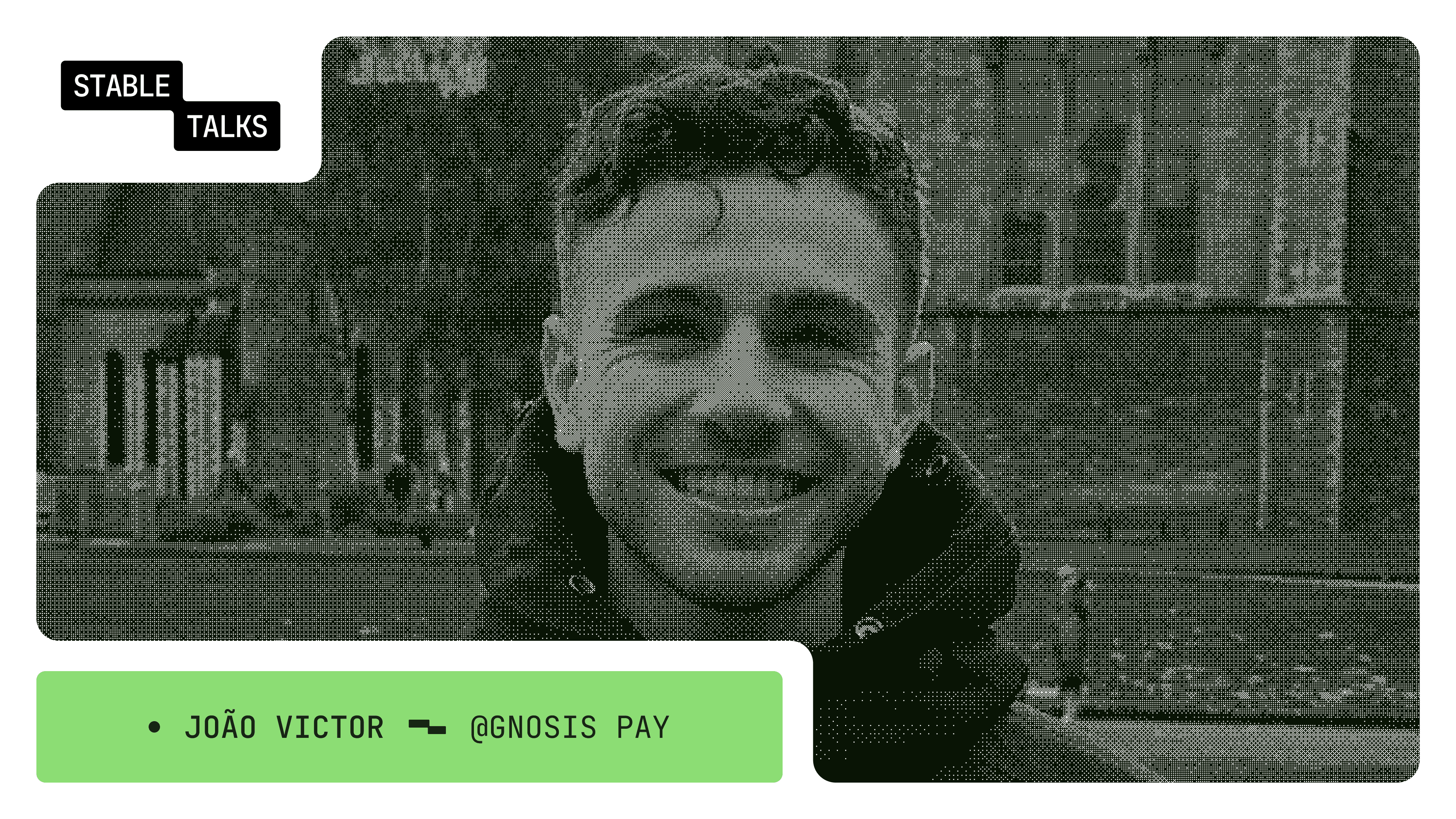
In the seventh episode of Season 2 of Stable Talks powered by Bitso Business, Caio Barbosa (Co-Founder & CEO at Lumx) and Julián Colombo (Senior Director, South America at Bitso) welcome João Victor Vieira, Business Developer at Gnosis Pay, to discuss how crypto cards are evolving from niche products into global payment infrastructure.
From Safe wallets to Visa partnerships, the conversation explores how Gnosis Pay bridges self-custody and traditional card networks, allowing users to spend stablecoins directly from smart wallets.
🎧 Listen to the full episode below or read on for the main highlights.

Highlights from the conversation
1. From B2C card to B2B infrastructure
“Instead of being the retailer, we realized we could power others to launch their own card programs.”
— João Victor Vieira
Gnosis Pay started as a consumer-facing crypto card in Europe.
Now, the focus has shifted to enabling companies to launch:
White-label card programs
Permissionless API-based integrations
Branded or unbranded virtual cards
The infrastructure model scales faster than retail.
2. The real challenge of launching a card program
Launching a card program isn’t just about tech.
João explains that companies must:
provide collateral covering several days of transaction volume
manage Visa relationships
handle regulatory and compliance requirements
survive until scale makes the business profitable
This complexity is why infrastructure players matter.
3. How the self-custodial card works
“The funds remain in a Safe smart wallet, the card just verifies and settles.”
Behind the scenes:
Each card is linked to a Safe smart wallet
Transactions are verified in seconds
Settlement happens using programmable logic
Anti-double-spend protections are built in
The result: users keep custody while still accessing Visa rails.
4. Yield + spending: DeFi meets payments
A recent upgrade allows users to:
Keep funds in yield-generating positions
Automatically top up spending balances
Combine DeFi rewards with everyday payments
This bridges two previously separate worlds.
5. Brazil as a breakout market
Brazil became Gnosis Pay’s fastest-growing region.
Why?
High crypto adoption
Strong demand for dollar exposure
IOF taxes increasing demand for alternatives
Travel use cases
In Brazil alone, adoption accelerated dramatically in just a few months.
6. Consumer vs enterprise opportunity
While retail spending is growing, the episode also explores:
Corporate card use cases
Treasury and business spending
infrastructure partnerships
Stablecoin cards may expand far beyond retail.
7. Multi-chain and global expansion
With expansion planned across:
Latin America
North America
Asia
Gnosis Pay is exploring multi-chain integrations and broader issuance models to support global crypto-native users.
From “HODL” to real usage
Crypto is no longer just about holding assets.
This episode highlights a clear transition:
stablecoins are becoming usable money , not just speculative instruments.
And self-custodial infrastructure may play a major role in that shift.
How does Gnosis Pay allow users to spend stablecoins with a Visa card?
Gnosis Pay links each card to a Safe smart wallet where users maintain self-custody of their funds. When a transaction occurs, it is verified in seconds using programmable logic with anti-double-spend protections. Settlement happens onchain while the payment flows through Visa rails — letting users spend crypto without giving up custody.
What is the difference between Gnosis Pay's B2B and B2C card models?
Gnosis Pay started as a consumer-facing crypto card in Europe but shifted to a B2B infrastructure model. Instead of being the retailer, they now enable other companies to launch white-label card programs, permissionless API-based integrations, and branded or unbranded virtual cards. The infrastructure model scales faster than retail because it serves multiple companies simultaneously.
Can users earn DeFi yield while spending through a crypto card?
Yes. A recent Gnosis Pay upgrade allows users to keep funds in yield-generating DeFi positions while automatically topping up their spending balances when needed. This combines the benefits of decentralized finance with everyday payment functionality, creating a seamless experience where idle funds generate returns until they are spent.
Why is Brazil one of Gnosis Pay's fastest-growing markets?
Brazil combines high crypto adoption, strong demand for dollar exposure, increasing IOF taxes on traditional foreign exchange, and frequent travel use cases. These factors create a natural market for crypto-linked cards that allow users to spend stablecoins directly, bypassing traditional FX costs while maintaining the convenience of a standard Visa card.


