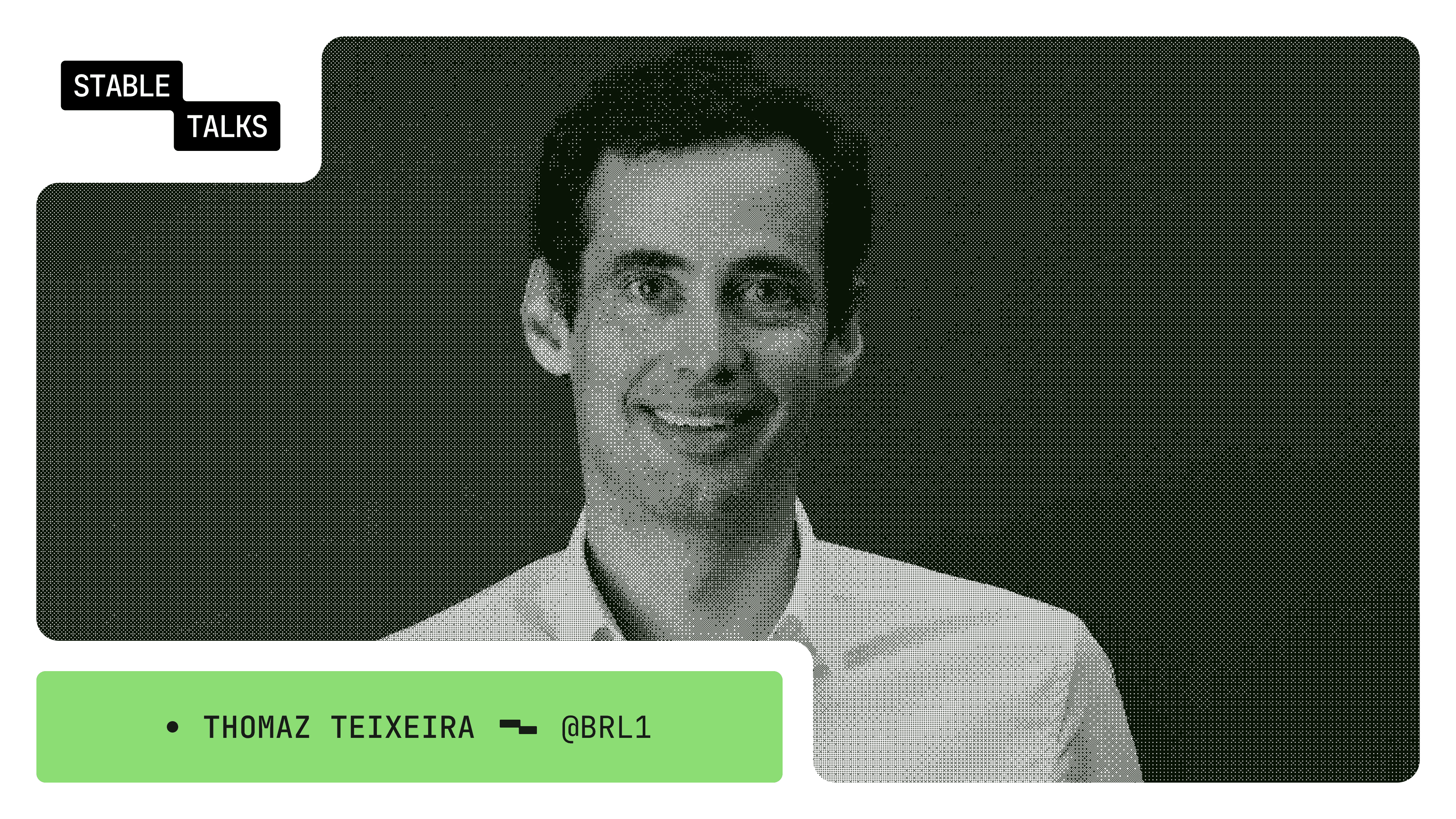
In the fifth episode of Season 2 of Stable Talks powered by Bitso Business, Caio Barbosa (Co-Founder & CEO at Lumx) and Julián Colombo (Senior Director, South America at Bitso) welcome Thomaz Teixeira, CEO of BRL1, for a deep conversation on why the Brazilian Real is emerging as a powerful candidate for on-chain infrastructure.
Thomaz has been building stablecoins since 2019 and worked closely with Mercado Bitcoin, Stellar, CVM and the Central Bank’s LIFT program. His experience provides a rare inside perspective on what it really takes to put a local currency on-chain — from regulation to liquidity to market design.
🎧 Listen to the full episode below or read on for the main highlights.

Highlights from the conversation
1. Why does the world need a BRL stablecoin?
“If I think and operate in BRL, why must I hold USD on-chain?”
— Thomaz Teixeira
Thomaz explains that the value proposition mirrors USDT’s early use cases:
Brazilians who think in Real but want the speed and programmability of digital money
Foreigners who want access to BRL but cannot easily open a local bank account
Stablecoins become a bridge to both.
2. The main use case today: arbitrage and market-making
“Whoever gets to the arbitrage first gets it all.”
— Thomaz Teixeira
BRL1 is already among Brazil’s top traded digital assets because traders gain:
Zero FX slippage compared to USD stablecoins
Faster execution
More efficient liquidity movements across exchanges
For market makers, holding BRL on-chain reduces costs and improves margins.
3. How BRL1 fits into Brazil’s fintech stack
Brazil is one of the world’s most advanced financial infrastructures thanks to Pix, open finance and a highly digital regulatory environment.
BRL1 benefits directly from this:
Pix powers its fiat settlement layer
open banking enables multi-bank reserves
transparency frameworks support credibility and audits
Stablecoins don’t compete with Pix, they extend Brazil’s rails to a global, programmable layer.
4. Yield: a core part of Brazil’s stablecoin story
“Even when users don’t earn yield directly, yield helps subsidize the ecosystem.”
— Thomaz Teixeira
Brazil’s structurally high interest rates make BRL-denominated assets attractive.
While regulation limits how yield is offered to end users, yield still:
Subsidizes infrastructure
Compensates exchanges and market makers
Helps maintain low fees and frictionless UX
5. CBDCs, Drex and private stablecoins
“If anything, CBDCs make stablecoins even more necessary.”
— Thomaz Teixeira
Thomaz breaks down the evolution of Drex, Brazil’s digital Real initiative:
Drex aimed to support tokenized financial markets
Its pilot used a permissioned version of Hyperledger Besu
Recent shifts raise questions on next steps
He argues that private stablecoins, backed by regulated institutions, will remain essential to bridge real-world assets, DeFi, and tokenized markets.
6. The tokenization ecosystem and capital markets
Brazil is becoming a global hub for tokenized RWAs.
Some platforms already use BRL stablecoins internally to:
Settle trades
Maintain collateral
Automate payouts
But without Drex’s permissioned network, connecting siloed markets (like auto finance or receivables) will take more time.
7. Interoperability and on-chain FX: BRL1, MXNB and USD
“Liquidity has a life of its own.”
— Thomaz Teixeira
BRL1 ↔ MXNB direct conversion will grow over time, but today:
USD liquidity still acts as the “informational bridge”
A BRL1–USDC–MXNB path may remain efficient for large transfers
Local stablecoins will reduce reliance on USD gradually, not instantly
Still, just being able to move BRL ↔ MXN without banks is a major step forward.
BRL on-chain: unlocking a borderless Real
The episode shows a clear conclusion:
BRL stablecoins are not just a tool, they’re becoming infrastructure.
They expand access to Brazilian markets, improve liquidity efficiency, enable programmable finance, and lay the groundwork for the next evolution of tokenized assets.
“We’re making BRL borderless.”
— Thomaz Teixeira (BRL1)