
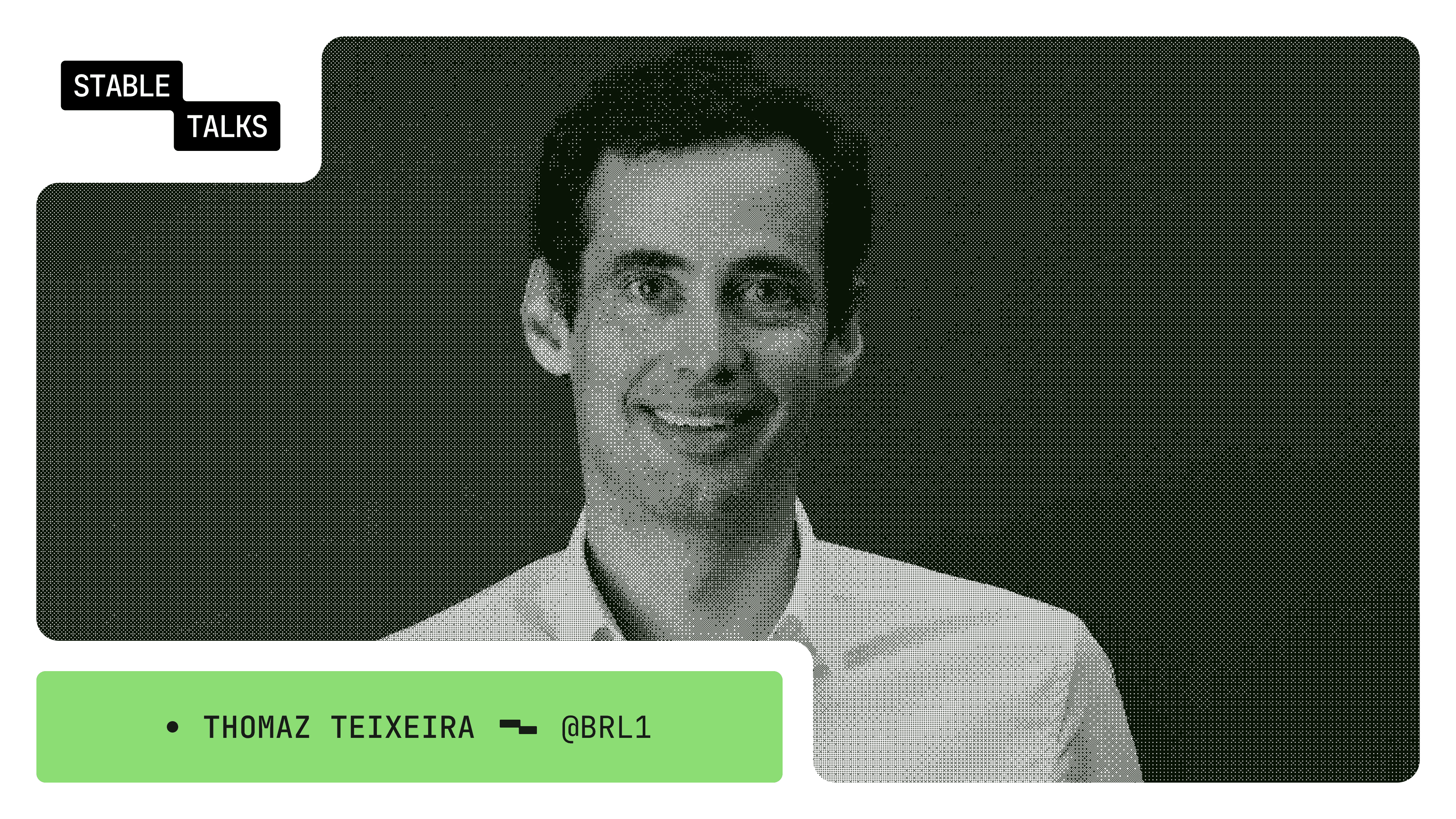
In the fifth episode of Season 2 of Stable Talks powered by Bitso Business, Caio Barbosa (Co-Founder & CEO at Lumx) and Julián Colombo (Senior Director, South America at Bitso) welcome Thomaz Teixeira, CEO of BRL1, for a deep conversation on why the Brazilian Real is emerging as a powerful candidate for on-chain infrastructure.
Thomaz has been building stablecoins since 2019 and worked closely with Mercado Bitcoin, Stellar, CVM and the Central Bank’s LIFT program. His experience provides a rare inside perspective on what it really takes to put a local currency on-chain — from regulation to liquidity to market design.
🎧 Listen to the full episode below or read on for the main highlights.

Highlights from the conversation
1. Why does the world need a BRL stablecoin?
“If I think and operate in BRL, why must I hold USD on-chain?”
— Thomaz Teixeira
Thomaz explains that the value proposition mirrors USDT’s early use cases:
Brazilians who think in Real but want the speed and programmability of digital money
Foreigners who want access to BRL but cannot easily open a local bank account
Stablecoins become a bridge to both.
2. The main use case today: arbitrage and market-making
“Whoever gets to the arbitrage first gets it all.”
— Thomaz Teixeira
BRL1 is already among Brazil’s top traded digital assets because traders gain:
Zero FX slippage compared to USD stablecoins
Faster execution
More efficient liquidity movements across exchanges
For market makers, holding BRL on-chain reduces costs and improves margins.
3. How BRL1 fits into Brazil’s fintech stack
Brazil is one of the world’s most advanced financial infrastructures thanks to Pix, open finance and a highly digital regulatory environment.
BRL1 benefits directly from this:
Pix powers its fiat settlement layer
open banking enables multi-bank reserves
transparency frameworks support credibility and audits
Stablecoins don’t compete with Pix, they extend Brazil’s rails to a global, programmable layer.
4. Yield: a core part of Brazil’s stablecoin story
“Even when users don’t earn yield directly, yield helps subsidize the ecosystem.”
— Thomaz Teixeira
Brazil’s structurally high interest rates make BRL-denominated assets attractive.
While regulation limits how yield is offered to end users, yield still:
Subsidizes infrastructure
Compensates exchanges and market makers
Helps maintain low fees and frictionless UX
5. CBDCs, Drex and private stablecoins
“If anything, CBDCs make stablecoins even more necessary.”
— Thomaz Teixeira
Thomaz breaks down the evolution of Drex, Brazil’s digital Real initiative:
Drex aimed to support tokenized financial markets
Its pilot used a permissioned version of Hyperledger Besu
Recent shifts raise questions on next steps
He argues that private stablecoins, backed by regulated institutions, will remain essential to bridge real-world assets, DeFi, and tokenized markets.
6. The tokenization ecosystem and capital markets
Brazil is becoming a global hub for tokenized RWAs.
Some platforms already use BRL stablecoins internally to:
Settle trades
Maintain collateral
Automate payouts
But without Drex’s permissioned network, connecting siloed markets (like auto finance or receivables) will take more time.
7. Interoperability and on-chain FX: BRL1, MXNB and USD
“Liquidity has a life of its own.”
— Thomaz Teixeira
BRL1 ↔ MXNB direct conversion will grow over time, but today:
USD liquidity still acts as the “informational bridge”
A BRL1–USDC–MXNB path may remain efficient for large transfers
Local stablecoins will reduce reliance on USD gradually, not instantly
Still, just being able to move BRL ↔ MXN without banks is a major step forward.
BRL on-chain: unlocking a borderless Real
The episode shows a clear conclusion:
BRL stablecoins are not just a tool, they’re becoming infrastructure.
They expand access to Brazilian markets, improve liquidity efficiency, enable programmable finance, and lay the groundwork for the next evolution of tokenized assets.
“We’re making BRL borderless.”
— Thomaz Teixeira (BRL1)
Why does the world need a Brazilian Real stablecoin like BRL1?
BRL1 addresses a fundamental gap: Brazilians who think and operate in Real but want the speed and programmability of digital money, and foreigners who want access to BRL but cannot easily open a local bank account. A BRL stablecoin serves as a bridge for both groups, enabling native-currency on-chain operations without forced conversion to USD.
What is the main use case driving BRL1 adoption today?
The primary use case is arbitrage and market-making. BRL1 is already among Brazil's top traded digital assets because traders gain zero FX slippage compared to USD stablecoins, faster execution, and more efficient liquidity movements across exchanges. For market makers, holding BRL on-chain reduces friction and unlocks opportunities that dollar-denominated stablecoins cannot serve.
How do Drex and private BRL stablecoins like BRL1 coexist?
Drex (Brazil's CBDC) and private BRL stablecoins like BRL1 serve different purposes. Drex focuses on wholesale interbank settlement under Central Bank control, while BRL1 operates on public blockchains for retail and commercial use cases. The two can be complementary: Drex provides the institutional backbone while private stablecoins offer programmability and accessibility for everyday financial operations.
What challenges exist in building on-chain FX between local-currency stablecoins?
On-chain FX between stablecoins like BRL1 and MXNB faces challenges in liquidity depth, price discovery, regulatory compliance across jurisdictions, and the need for reliable oracle infrastructure. Building functional FX markets requires not just technology but also market makers, institutional participation, and regulatory frameworks that recognize cross-border stablecoin flows as legitimate financial activity.


