

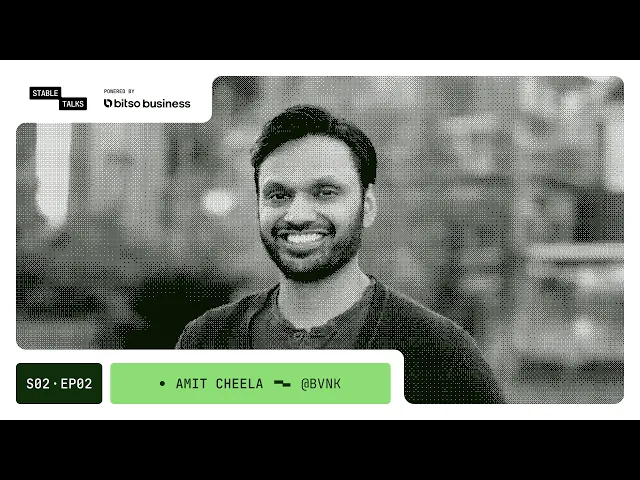
In the second episode of Season 2 of Stable Talks powered by Bitso Business, Caio Barbosa (Co-Founder & CEO at Lumx) and Julián Colombo (Senior Director, South America at Bitso) welcome Amit Cheela, US CEO at BVNK, to discuss how stablecoins are moving from speculation to real financial infrastructure.
Amit shares his journey from hedge funds to BlockFi and now BVNK, reflecting on lessons learned from the highs and lows of the crypto market. The conversation highlights the hidden costs in card programs, BVNK’s rapid growth in the US, and how regulation is shaping adoption differently in the US and Europe.
🎧 Listen to the full episode below or read on for the main highlights of the conversation.
Highlights from the conversation
1. From hedge funds to stablecoins
“Going from traditional finance to BlockFi taught me the power, and risks, of scaling fast. Stablecoins felt like a natural next step.”
— Amit Cheela
Career journey through hedge funds, BlockFi, and BVNK
Lessons from the rise and collapse of BlockFi
Why stablecoins became a more resilient focus
2. The hidden costs of card programs
“Pre-funding card programs consumes huge amounts of capital, stablecoins can unlock real-time funding instead.”
— Amit Cheela
Why card programs tie up liquidity with pre-funding
Challenges of banking hours, holidays and cross-border flows
Stablecoins as a tool for just-in-time settlement
3. BVNK’s growth in the US
“In July, we crossed $400M in volume, and it’s just the beginning.”
— Amit Cheela
BVNK’s strategy to expand with regulated partners
Scaling volumes from tens of millions to hundreds of millions
Partnerships with Paxos, Worldpay, and High Note
4. Regulation: US vs. Europe
“Europe is prescriptive with MiCA, while the US is about expectations. Both have pros and cons.”
— Amit Cheela
Key differences between US and European regulatory approaches
Compliance challenges in a fragmented market
How institutions choose where to build
5. Stablecoins beyond USD
“The dollar has clear advantages, but there’s pressure to build local currency stablecoins too.”
— Amit Cheela
Debate on non-USD stablecoins and fragmentation risks
Liquidity challenges with local stablecoins
Why USD-backed stablecoins remain dominant
6. Adoption curve: slowly, then all at once
“It starts slow, regulation, education, trust. Then everything clicks into place.”
— Amit Cheela
Barriers to mainstream adoption
Role of compliance and bank confidence
Why adoption may accelerate suddenly
Stablecoins: building real financial infrastructure
This episode explores how stablecoins are no longer just an experiment but an emerging foundation for global finance. Amit’s perspective shows both the opportunities and challenges of integrating stablecoins into payment systems, from card funding to cross-border flows. For Latin America and beyond, the lesson is clear: adoption may be uneven, but the direction is inevitable.
“Adoption is coming, slowly, then all at once.”
— Amit Cheela (BVNK)
What is BVNK and how is it using stablecoins for payments?
BVNK is a financial infrastructure company that helps businesses move money using stablecoins. Led by US CEO Amit Cheela, BVNK is rapidly growing in the American market by offering real-time funding solutions that replace the capital-intensive pre-funding requirements of traditional card programs, making cross-border payments faster and more capital-efficient.
What are the hidden costs in traditional card programs that stablecoins can solve?
Traditional card programs require companies to pre-fund large amounts of capital to cover transactions, tying up liquidity that could be used elsewhere. Banking hours, holidays, and cross-border delays add further friction. Stablecoins can unlock real-time funding instead, reducing the capital locked in pre-funding and enabling 24/7 settlement regardless of time zones or banking schedules.
How is stablecoin regulation different between the US and Europe?
The US is advancing through legislation like the GENIUS Act, creating a competitive framework that encourages innovation while establishing guardrails. Europe, through MiCA (Markets in Crypto-Assets), has taken a more prescriptive regulatory approach with centralized oversight. These different philosophies are shaping how companies build and deploy stablecoin products in each market.
What lessons from BlockFi's collapse apply to stablecoin companies today?
BlockFi's rise and collapse demonstrated the risks of scaling too fast without sustainable fundamentals, particularly around yield products and risk management. For stablecoin companies, the key lesson is that resilience matters more than speed — focusing on compliant infrastructure, transparent reserves, and sustainable business models rather than aggressive growth at the expense of stability.


